

Competitive messaging for marketing and sales empowerment
Any communications strategy –whether marketing, sales or bid document creation – depends upon the critical, complex and challenging requirement for competitive messaging.
Some things are too important to leave to AI.
For over 30 years, we have been providing messaging consultancy for marketing, sales and bid communications.
Our clients have included many of the world’s largest technology organisations including Arqiva, BT Global Services, Ciena, Fiserv, Hitachi Vantara, Grant Thornton, HP, IBM, Merrill DataSite, TomTom, Travelport and Unisys – as well as numerous smaller companies.
As a content-led company our in-depth approach to messaging tends to be far more detailed than the services offered from other organisations. Instead of a few pages of above-the-line sound bites, our approach results in a highly defined set of messages for your company, along with detailed rationale and supporting information which can be used as the basis for future collateral.
-
Whether you are focused on marketing for a campaign, a bid, product or an entire organisation, you need to think seriously about who you are, what your unique selling point is, and how that is wholly compelling to your customers.
That’s why our standard approach to messaging is designed to produces substantial documents (sometimes as long as 20 pages) organised around a clear combination of ‘super message’ plus supporting messages.
Structurally, the ‘super message’ is in the form of ‘Who?’, ‘What?’, ‘How?’ and, sometimes, ‘Why?’. We tend to focus on just five or six supporting messages, sometimes grouped according to target audience. Too many, and there is a risk that the messaging can become diluted.
In-depth messaging such as this – based upon research and interviews – creates a compelling set of messages that truly reflect your competitive difference. Because the process necessarily involves key stakeholders, it makes it possible to refine and document the messaging that will be used across a business.
Moreover, because the messaging documents we produce are so substantial, they can be used to underpin every single communication activity around the business. You can direct and empower sales, marketing and PR activities both within your company as well as those produced by external agencies. This ensures that all communications are consistent – even those produced at arm’s reach from your business. Indeed, the value can be extended yet further to areas such as customer service, support and internal communications.
-
The term ‘challenger messaging’ refers to a messaging approach that empowers sales teams to engage with customers more effectively and, ultimately, to increase their commissions and revenues for the business.
Challenger messaging is similar to in-depth messaging in terms of the process and the techniques we use to create it – with research and interviews required to understand the unique value of your business and proposition. However, challenger messaging also includes an overview of your target customers’ pain points, concerns, and constraints – helping the sales force to begin sales conversations that resonate with customers and engage them from the outset.
Critically, challenger messaging also asks target customers to challenge traditional ways of working or doing business, which are no longer effective or fit for purpose. This sets the scene for a ‘better way’ of doing things, ultimately allowing you to position your solution as the best possible way forward.
Because challenger messaging begins with customers’ pain points and ends with your unique proposition as the solution, it is a highly effective sales enablement tool. However, challenger messaging can also be converted into a wide range of deliverables to support your marketing efforts, from thought leadership white papers, to web copy and, often, blogs as well.
Writing Machine has delivered successful challenger messaging projects for several large tech companies, including Hitachi Vantara and Ciena.
-
Both types of messaging engagements follow a similar process.
Desk research
Thorough desk research, including reviewing available information about the solution/service and researching the marketplace and competitor offerings ensures that stakeholder interviews are as fruitful as possible.Phone interviews with key stakeholders
Detailed exploratory phone interviews with a small number of key stakeholders not only capture information but are designed to provoke thought in order to refine – and often challenge – thinking.Transcription and deconstruction
Transcribed interviews are deconstructed using Microsoft Word’s outline view – a powerful technique we also teach as part of our Structured Writing Method courses – to produce a master working document which combines the thoughts of all interviewees grouped according to themes.Documenting the messaging
The master working document – plus any relevant desk research – is used to enable our consultant writer to create the first draft of the deliverable(s). The output at this stage can vary: challenger messaging engagements, for example, have a very particular structure. Similarly, many clients want the outputs to include usable pieces of collateral such as a brochure or white paper. We may also produce a series of thought leadership blogs at the same time.Feedback and amends
Once we have sent you the messaging suite of documents, we welcome all stakeholder feedback (either via email or phone) and will provide a revised version if required.
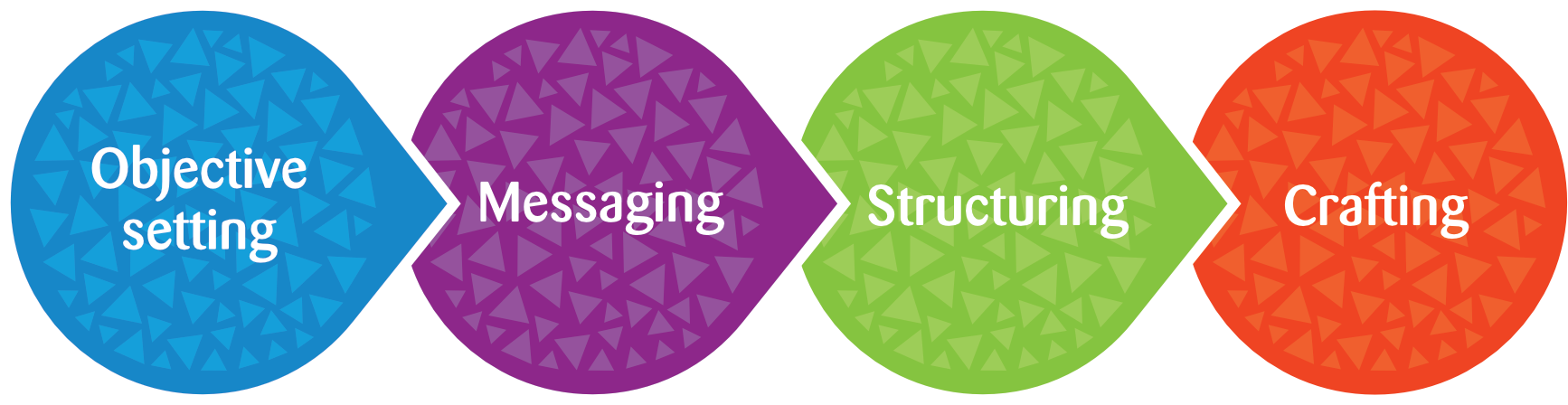
Messaging is a key part of our unique Structured Writing Method. This approach to thinking and writing provides a logical, linear process that we follow as an agency and teach as an academy. It is applicable to every business and to every business document.