

Writing for Bids
Writing Machine’s unique Writing for Bids enables individuals and teams to write clearer, more compelling, more professional and far more competitive bid and pitch documents.
Writing is an important part of most professional lives. Being able to communicate a message clearly and concisely is an incredibly important skill – whether that’s when writing reports, emails, marketing documents or pre-sales materials. Poor writing, meanwhile, can lead to frustration, miscommunication, and a loss of reputation and sales.
This course is based on the tried-and-tested specialist techniques used by our agency to provide writing services to companies such as Alcatel-Lucent, BAE Systems, BT Global Services, Carter Jonas, Experian, HP, Kapsch CarrierCom, QinetiQ, Siemens, SITA and TomTom.
What will you learn?
You will be taught a variety of techniques and processes to follow in order to write bid documents that are clearer, more concise, compelling and competitive. By teaching an effective and unique writing process, the course will help you and your team become much more productive.
On completion of this course, you will be able to:
Implement an effective writing process
making bid creation more efficient, and leading to better quality tender documentsIdentify key messages from existing source material
to speed up the transition from subject matter to sales bidFormulate sophisticated, highly competitive messages
whether for executive summaries or for answering complex bid questionsEffectively plan and structure lengthy bid and pitch documents
using structured writing techniques and Microsoft Word’s Outline View functionality to ease the stress of managing document creationRapidly structure executive summaries
using the messaging created earlier and Microsoft Word’s Outline ViewSuccessfully answer complex bid questions
to optimise scoringUse storyboards to improve writing efficiency
by enabling editorial ideas to be captured, negotiated and agreed before writing startsUse writing embellishments effectively
to make the writing clearer, more concise and compellingImprove the quality of writing across the tender document
to make bids and pitches more professional in appearance and easier to skim-readProofread your writing
to ensure your bid documents are free from typos, grammar and punctuation mistakes
Your training options
-
eLearning available through this site
The eLearning is available to buy through this site.
-
On-site, face-to-face training + eLearning
Many companies recognise how valuable it can be to have one of our trainers spend time with their team. This model features a one- or two-day classroom engagement designed to introduce the Structured Writing Method to teams. The day is typically located at your company premises and is focused on the specific needs of individual cohorts.
A classroom training day is augmented with the eLearning, to create a blended learning solution.
This has two important benefits.
It enables the classroom day to be more focused
During the classroom session we can focus on exploring the specific needs of the cohort on the day.Blended learning is ideal for writing training
A blended learning approach is ideal for learning a soft skill such as writing.
-
Remote learning sessions + eLearning
Our blended virtual training model is an excellent alternative to face-to-face blended writing training and the perfect solution for those needing to train geographically dispersed teams including those working from home.
-
Remote mentoring and editorial consultancy
For a small number of clients we are available to provide ongoing one-to-one editorial support from Paul Ayling, founder of Writing Machine and creator of the Structured Writing Method. This is appropriate for both individuals and members of marketing or bid teams. Provided on a time and materials basis, this engagement can include training, writing, messaging, strategy, critical feedback and quality control.
If this sounds of interest, please contact us to find out more →
-
Scorm-compliant eLearning modules for corporates and institutions
For those wishing to train large numbers of learners, we can make the eLearning materials available as a site licence.
Writing for Bids eLearning lessons
Writing for Bids eLearning is available as an enterprise site licence for organisations wishing to upskill large numbers of people across the organisation. It is also provided as part of a blended training delivery with classroom or virtual classroom courses.
-
The first element of Writing for Bids is objective setting. What are you trying to communicate? Who are you writing for? What do you want them to do when they have finished reading? This lesson includes exercises to get you thinking clearly about what communications objectives are and how to create them.
-
In this lesson, you discover how to analyse the requirements of a bid to work out exactly what your prospect is asking, how you can best fulfil those requirements and – crucially – whether your organisation should be submitting a bid at all.
-
This session reminds you that putting words on the page should be the very last thing you do. Long before this, you should think about who you’re writing for and what message you want to communicate to them. This lesson gives you a task to communicate a particular message to a number of individuals, and encourages you to think about your audience, your objectives and to combine these thoughts to create messages. Marketing and pre-sales messages, for example, are characterised as being necessarily competitive.
-
This lesson teaches a tried-and-trusted messaging method for creating clear, compelling and competitive messages. These will form the key elements used when structuring an executive summary in a later lesson.
-
If your job is to answer one or more questions in a tender document, it is important to know how to create messages that are clear, concise, competitive and compelling. This lesson shows you how.
-
In this lesson, you will learn how to use Microsoft Word’s extremely powerful Outline View tool to help you rapidly and more effectively structure your writing.
-
Not all RFPs allow you to write an executive summary. But if you are given that option. then it is a great opportunity to communicate your competitive position. This lesson provides clear guidelines on how best to structure your executive summary. It shows how the structure should communicate your competitive messages and discusses where and how the other elements of your executive summary should be included.
-
Failing to answer the question properly is, sadly, one of the worst crimes committed in bid responses. In this lesson you will learn how to break down a question into its key components to make sure you answer it fully. We also explore the importance of assigning appropriate word counts to different aspects of your answer.
-
Structuring is also key to creating a plan (or storyboard) for a bid answer. You can then show this to the final review team at an early stage – before you write – enabling you to often cut out hours of unnecessary revision time. This lesson will show you how to create a storyboard, and use it to get your bid answers approved internally before you craft your writing.
-
Just like web readers, procurement people tend to skim-read bid documents – looking for things they can score. In this lesson, we will look at a variety of useful techniques that will enable you to create bid documents that can be skim-read by your prospects. You will see how you can use devices such as headings, bullets, boxes and bold text to make your documents simple and manageable to navigate and read.
-
This lesson asks: ‘How are you going to hold your reader’s interest if your text is uninspiring and dull?’. You’ll learn how to engage your readers by turning facts into benefits, and by writing lively, direct sentences.
-
It is important that your bid documents convey your proposition as clearly as possible. This lesson shows you how to cut jargon from your bids, and how to use words and sentences that are as short and simple as possible.
-
Writing with authority is important for internal documents. But it can also be critical for external facing documents offering consultative advice. This lesson looks at the particular challenges of such documents and will give you guidance on authoritative structure and language. In addition, it will give advice on when to provide legal caveats, and how best to incorporate them.
-
Poor grammar and punctuation create the effect of an unprofessional organisation. This lesson clears up a number of common grammatical queries, and shows you the correct way to use punctuation marks such as colons, semi-colons and apostrophes.
-
As you can imagine, a few silly mistakes in a bid document can undo all the hard work that you’ve put into it. So finally, and appropriately perhaps, the Structured Writing Method finishes with a lesson about proofreading, in which you will learn our top 10 tips to help you improve the accuracy of your writing.

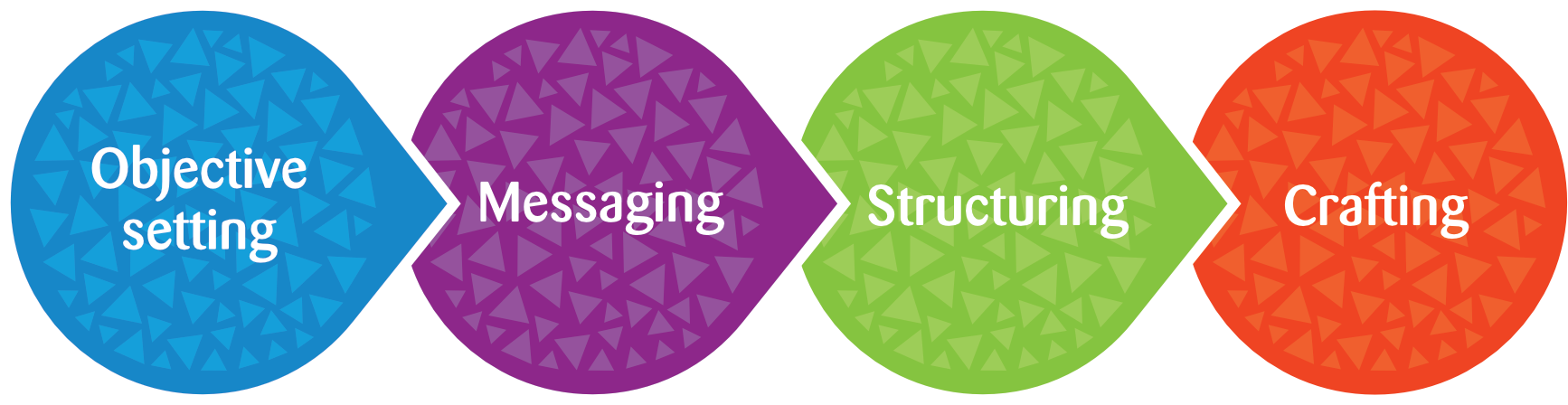
Writing for Bids teaches you our unique Structured Writing Method. This approach to thinking and writing provides a logical, linear process that we follow as an agency and teach as an academy. It is applicable to every business and to every business document.