

Thinking & Writing
Transforming access, student attainment and outcomes
Thinking & Writing is an eLearning course for students. It has been developed to provide effective training in thinking and writing for academic work, and to develop skills which will be invaluable in professional life.
When students have completed Thinking & Writing, they will be able to write more clearly and logically and do so with much greater confidence and efficiency. The ten interactive modules are designed to promote inclusivity and accessibility, targeting confidence, skills, attainment and outcomes.
Thinking & Writing: an overview
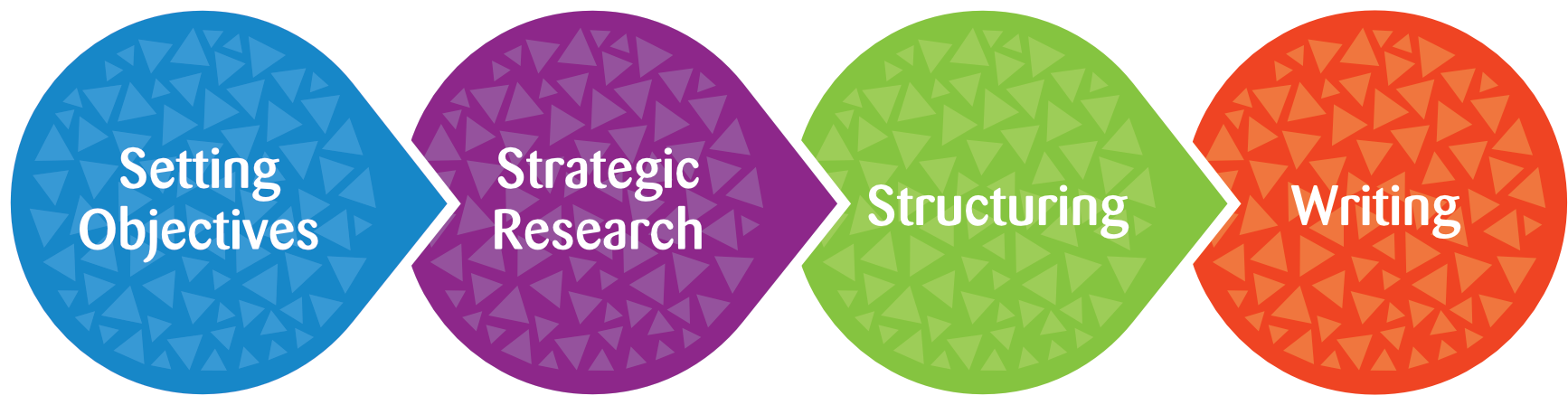
Thinking & Writing is a tried-and-tested process that has the power to transform student writing, attainment and outcomes. By following this organized approach, students will be able to produce written work that is well-structured, clear, concise and engaging. The process has four key stages: ‘Setting Objectives’, ‘Strategic Research’, ‘Structuring’ and ‘Writing’.
Stage 1: Setting objectives
Before students begin to conduct their research and before they begin to structure their assignment, they need to think about what they are doing – and why. They also need to be clear about the scope of the task and what is appropriate in terms of their time and effort.
1. Thinking about your writing task strategically
This lesson shows students how to read and understand any instructions, marking criteria and learning objectives they may be given for a written assessment. It will also help them to understand the value of harnessing their own personal objectives.
2. Unpacking the question: a four-step process
This lesson gives students the confidence to think about how to make the question their own. It teaches a four-step process for unpacking a question so they can research and structure their argument effectively.
Stage 2: Strategic Research
The second stage of Thinking & Writing focuses on the most effective ways of researching for academic writing. Most research should be done after students have set their objectives and unpacked the question, but before they work on the final structure of their assignment. Using the Thinking & Writing process, they will learn to develop focused and time-efficient research strategies that will provide them with the knowledge and evidence that they need.
3. Identify what you do – and do not – need
In this lesson, students will think about what knowledge they already have and consider what further information they need. They will learn how to use their reading lists and set texts to their advantage, as well as where to look for specific further information.
4. Read efficiently and effectively
This lesson will provide students with some of the key techniques they need to read efficiently and effectively. They will build on the focused strategies they established in the previous lesson, and will practise limiting the scope of what they are looking for to keep their research specific.
5. Reference from the outset
Taking detailed bibliographical notes throughout the ‘Strategic Research’ stage will improve students' writing efficiency, confidence and authority. It will also save time, improve marks and help them avoid plagiarism. This lesson teaches the benefits, as well as the basics, of noting bibliographic material at the same time as students are reading.
Stage 3: Structuring
The third stage of Thinking & Writing focuses on how to structure written assignments. This is where everything students have done so far – from establishing key terms and instruction words and clarifying and unpacking of the question to the identification of strategic research and structural elements – all come together.
Learning how to structure – before writing – is one of the most important academic skills to acquire. Following the processes of the ‘Structuring’ stage ensures that students consider the most persuasive way to present their argument and the material they have to justify it. It also enables them to create a logical narrative to guide their reader through their points. And, perhaps best of all, it saves them time when writing.
6. The power of thinking with structure
This lesson focuses on the skills and techniques involved in clear structuring. It explains why using descriptive headings and subheadings helps students define their argument and organize their content. Once students understand the logic behind the ‘Structuring’ stage, planning will become much more straightforward.
7. Thinking with structure using Outline View
This lesson introduces a powerful feature of Microsoft Word called Outline View which can help students to develop detailed plans quickly and easily for their assignments. They will also see how this tool can help organize research and incorporate specific evidence and sources.
Stage 4: Writing
After all the thinking of ‘Setting Objectives’, ‘StrategicResearch’ and ‘Structuring’, defining and refining an argument and the evidence for it – the final stage of Thinking & Writing focuses on writing itself.
This stage introduces techniques for ensuring that the writing style is clear and appropriate for an academic audience and for helping students edit their work effectively. They will also discover tips to help them avoid common grammar and punctuation pitfalls as well as guidance on how to proofread and check their work before submission.
8. Writing with clarity
This lesson includes guidance on converting descriptive headings and subheadings into navigational topic sentences. It encourages students to write shorter, simpler sentences and introduces a very helpful Microsoft Word tool: Readability Statistics.
9. Checking your writing
No matter how much thinking has gone into it, assignments will create a bad impression if they include typographical errors, spelling mistakes, repetitions, grammatical errors and problems with punctuation. In most institutions, students will lose marks if they submit written assessments with such errors. This is why editing, proofreading and checking references are the last – critical – tasks in the writing process.
10. Tips for checking grammar and punctuation
Good grammar and correct punctuation are the hallmarks of high-quality academic writing. Poor punctuation often makes writing hard to read and, in some circumstances, can dramatically change the meaning of a sentence. This lesson provides guidance on how to avoid some of the more common grammar and punctuation mistakes.
Your training options
-
eLearning available through this site
The eLearning is available to buy through this site.
-
Scorm-compliant eLearning modules for Higher Education institutions
For those wishing to train large numbers of learners, we can make the eLearning materials available as a site licence.

Key benefits for institutions
Inclusive, accessible and affordable
Thinking & Writing is designed inclusively to develop crucial thinking and writing skills across the undergraduate and postgraduate spectrum. (It is also ideal for foundation year, pre-sessional and international students). Site licences are affordable within discretionary budgets.
Diversifying flexible teaching and learning
Thinking & Writing diversifies active learning activities with asynchronous, scaffolded stages and lessons. Delivery can be co-curricular or embedded in teaching. No work loading is required and student engagement can be monitored.
Impacting access, attainment and outcomes
Thinking & Writing is inclusively designed and accessible to students from all backgrounds. It actively responds to equality, diversity and inclusivity imperatives and access, attainment and outcome initiatives.
Boosting student experience, satisfaction and success
Thinking & Writing boosts confidence as well as employability and essential life skills, regardless of socioeconomic background. It can mitigate dropout rates and help compensate for the effects of Covid-19 on sixth-form and undergraduate education.
Embedding employability in curricula
Thinking & Writing develops the transferable thinking, writing, critical, research and collaborative skills so valued by employers – as well as in education. It boosts attainment and confidence, and helps graduates stand out in the fast evolving AI and post-pandemic world of work.
Simple to deploy
Thinking & Writing can be deployed easily by Digital, Careers and Teaching and Learning professionals, as well as by academics.